


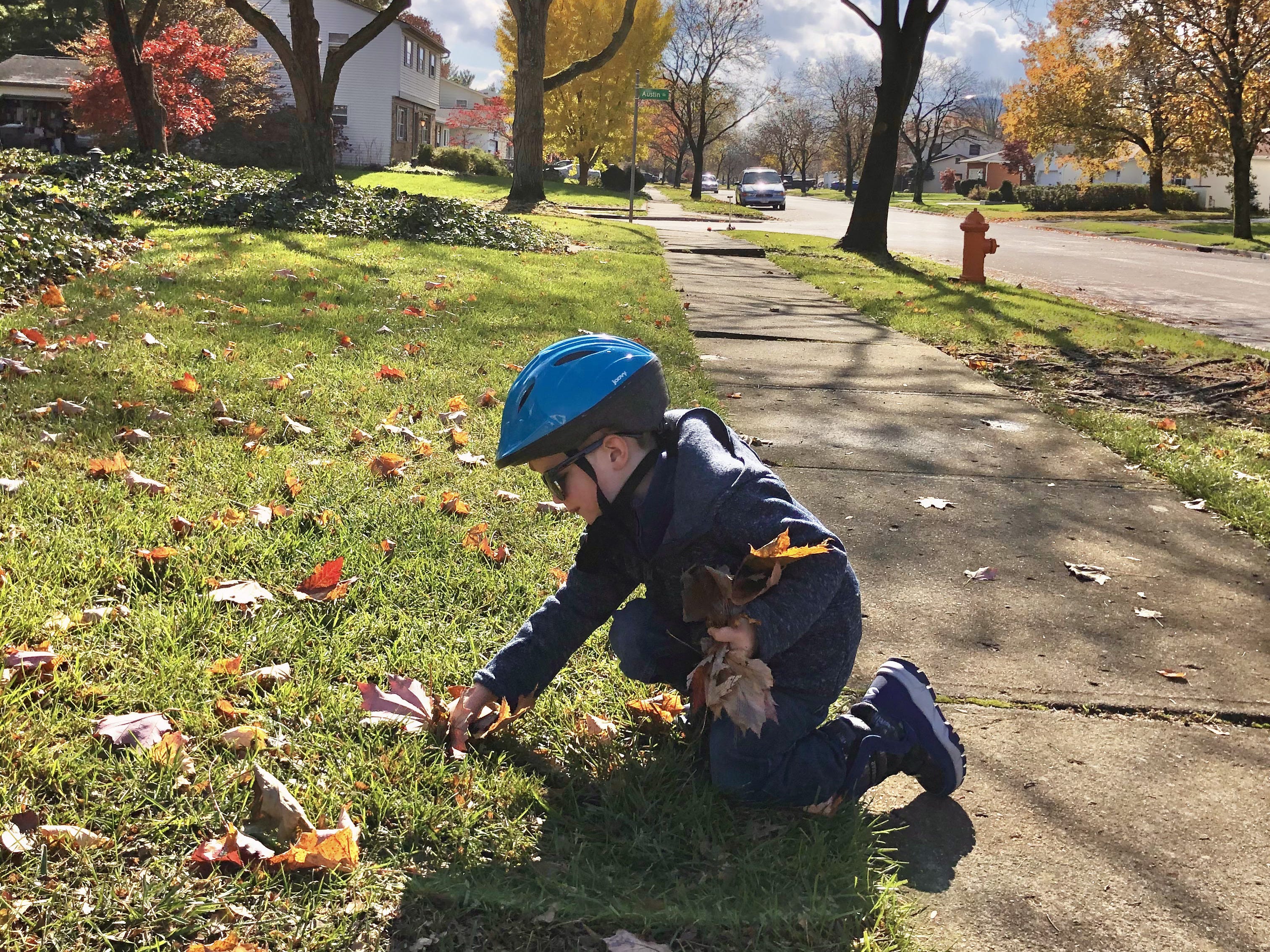
When my son was about four years old, he went through a phase where he insisted on picking up every single colorful leaf on our daily walk. I understand how adorable this sounds, and it was, the first few times. But eventually the compulsion was so urgent and so complete it became a menace. There were never enough pockets or jacket space or hands between us. A one block walk became an ordeal. Every two steps we were paralyzed by the wonder of more pretty leaves and the conundrum of where to put them all. Inevitably, we had to leave some behind, which, to his four year old mind, was an unbearable tragedy.
That year, our Autumn walks often ended with me picking up a weeping child and carrying him home, leaves spilling from his pockets the entire way. In typical mean-mom fashion, I wouldn’t let him take the leaves inside the house, so they sat in piles on either side of our garage door stoop, slowly turning brown and crispy.1
At the time, his fervor confounded me. I couldn’t reason with him—couldn’t tell him the leaves wouldn’t last—that their lovely colors would fade. I couldn’t convince him that their beauty was best enjoyed outside, in the moment, where they would glow brilliantly, but only for a short time.
Two weeks ago, I stood on the balcony of a hotel in Quebec and took in a panoramic view of changing leaves, and for a few minutes, I felt just like my four year old.
I had the sudden urge to take the scenery and blend it into a smoothie I could drink. I was desperate to somehow make the beauty a part of me, to transform it into something I could hold and cherish and carry with me always. It felt like I could never get enough.
I was in Quebec for a Common Ground Pilgrimage, a retreat centered around the sacred practices of reading, walking, silence, and community. Our text for the week was the first two novels in Louise Penny’s Inspector Gamache series, a long time favorite of mine.
We spent our days in deep conversation with each other, asking ourselves what community requires and when our brains are a scary place2 and what it means to have a place—a home—where you can show up fully as yourself. We lingered over baguette sandwiches, walked quietly (and sometimes chattily) along lakes ringed by fiery trees, laughed a lot, and cried a little, too.
I struggled at times to take it all in, wanting desperately to be present, knowing our time together was limited. Our chaplain called the experience “liminal,” and that feels exactly right. It was a time outside of time, a twilight we got to inhabit together, that magic hour just before the sun slips below the horizon.