


I read the first Hunger Games book as a newlywed. It was 2010 and Barack Obama was President. This was before we had ever heard the words Covid or Polymarket. Before Donald Trump told us he could shoot someone in the middle of Fifth Avenue and not lose a single vote. The Hunger Games felt like the best kind of dystopian fiction—close enough to reality that it was believable, but not so close that it made your skin crawl.
This morning I scrolled through images from the Met Gala, which is a thing we are apparently still doing. The red carpet was bursting with outlandishly wealthy people in extravagant costumes featuring extra arms (?!), dollar bill blindfolds, and gowns that took 761 hours to complete. Are we really that far off from the Capitol citizens, with their glass hats swarming with live bees or embedded jewels on artificially colored skin?
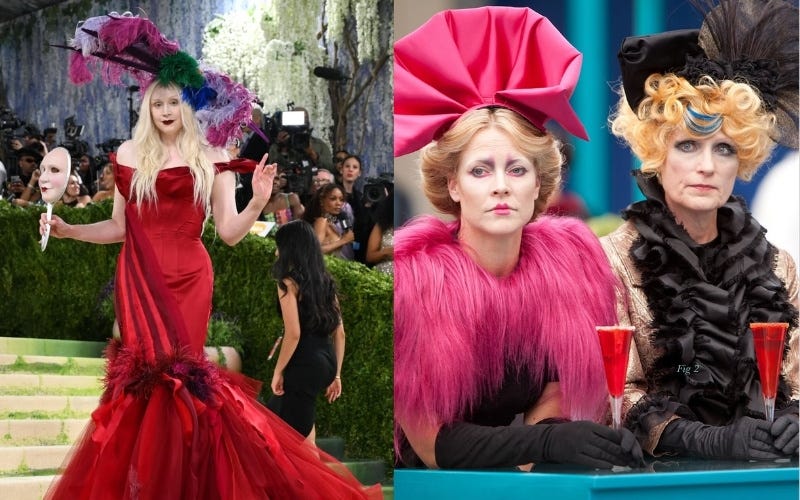
And then there’s the betting. Oh, the heartbreak of the betting. I would love to feel distantly horrified by the citizens of Panem betting on the odds of children dying in a game of their own creation, but instead I feel only a dreadful knowing. This year, Americans have placed over 1 billion dollars in bets on the war in Iran.
Are we not living in a world that feels like a reality show, obsessed with spectacle and entertainment over the needs of the common citizen? Are we not seeing, in the starkest terms, the suffering of the least of these juxtaposed against the increasing wealth of the few?
What do you do when the odds aren’t in your favor, when the powerful aren’t servants, but self-obsessed? What do you do when celebrities attend galas while children suffer in wars and deportation camps and homes without enough groceries to last the week?
What, my friends, do you do in the middle of the hunger games?
In Sunrise on the Reaping, the prequel to the Hunger Games trilogy, a young Haymitch Abernathy is sent to the 50th annual Hunger Games. It is an unjust reaping; his name is called as a replacement for another district 12 kid who flees and is killed by peacekeepers. But of course, there is no “just” reaping in a system designed to terrorize and oppress the many for the benefit of the few.
In the arena, an abundantly beautiful place filled with hidden poisons, Haymitch hopes to break the games, overthrowing the symbol of the Capitol’s power, indifference, and cruelty once and for all.
Of course, we know he won’t succeed. He tries. He makes a stir. But he ultimately fails. The reader knows it will take another 24 years before Katniss Everdeen finally wrecks the Hunger Games.
My heart aches when I think of those 24 years and of the 50 years of terror that proceeded them. The victory at the end of the story can’t erase the pain of those years. Haymitch’s story is so brutal that if I hadn’t read the other books, I might think Suzanne Collins was trying to drive us all to the white liquor.
Instead, I’d rather assume this is the story she thought needed to be told in this moment. A story not about one person who changed everything, but of a thousand tiny stitches woven into a tapestry of resistance.
So, what do we do when we’re in the middle of the Hunger Games?
Maybe it’s as simple as following the path of Haymitch and Maysilee, an unlikely pair of allies in the arena.
“What a luxury, to wake up to a breakfast of fresh cornbread, buttermilk, and peaches instead of having to scrounge for stale leftovers. Maysilee had the food all laid out on a tarp, like a party. She folded a pair of handkerchiefs into flowers for napkins, and even filled the bowl of the wineglass with some kind of pink blossom, likely poisonous, but undeniably decorative.”
We set a table. We spread a picnic blanket out in the wilderness, with whatever meager rations the day affords. We feed each other.
We take what we are given and make it beautiful, folding handkerchiefs into flowers and turning poisoned blossoms into a centerpiece.
We share what we have. We make unlikely allies. We drop chocolates on our enemies. We look out for the little guy.
We protect each other, care for each other, turn neighbors into family.
We remind each other of our dignity as human beings. We refuse to abandon each other, to turn on each other, or to harden our hearts. We resist the temptation of bitterness and despair.
We lament, remembering each of our losses, giving them all the space they need and deserve. We hold onto our humanity, together. We resist. We resist. We resist.
The slave trade existed in the United States for 246 years. Two hundred forty six devastating, vicious years. I wish it were different. It should haunt us that it took so long. I think one of the best questions we can ask God is “How long, Oh Lord?”
And yet, I refuse to believe those years were wasted. I refuse to let history forget all the big and tiny ways Black people resisted over those years: the meals they shared, the wounds they tended, the books they learned to read, the freedom songs they sung. For every Harriet Tubman there were a thousand Maysilee Donners imagining a different future for their children, setting tables, feeding people, making something beautiful in the midst of so much cruelty. Every tarp spread on the ground of the arena matters.
Of course, we all wish we could be Katniss Everdeen, the brave, self-sacrificing hero of the story, the one who leads the revolution. But this mom in middle America with her two kids and her small business is a lot more like Haymitch Abernathy. I might not be able to blow up the arena, but I can set a damn good table. And I’ll keep doing it until the whole thing finally crumbles.
“You were capable of imagining a different future. And maybe it won’t be realized today, maybe not in our lifetime. Maybe it will take generations. We’re all part of a continuum. Does that make it pointless?
“I just don’t know. But I do know you need someone different from me.”
“No, Haymitch. We need someone exactly like you.”
Your neighbor,

Hiyaa, loving your page!🥰 I just wrote this one, connecting art with society through pop culture (def worth checking out hihi)! 🌍💞https://notesofanoverthinkinggirl.substack.com/p/the-end-of-the-2010s-dystopian-genre?r=4bsz9b&utm_medium=ios
Your writing is so lovely, Courtney. And this post resonated with me so much, as I feel the same way right now. This line was amazing, "Met Gala or Hunger Games? The only difference I see is that Capitol citizens are still allowed to have wrinkles."